










Connected using Tier 1 transit

Four independent upstream carriers behind 7 metros on two continents. Diverse paths, dual-stack everywhere, and mitigation capacity that absorbs attacks in the backbone rather than at your port.

Upstream carriers

All four carry IPv4 and IPv6 and validate our announcements with ASPA. See on bgp.tools

IP transit: BGP to the whole internet

Full-table or default-route eBGP sessions over a dual-stack backbone, on a network you can verify on PeeringDB and bgp.tools.

A transit session is a BGP peering with our routers. You announce your prefixes to us; we announce a full routing table to you, or a single default route if you would rather keep your edge simple. From that moment your address space is reachable everywhere our network reaches, and the global internet is reachable through us.

Sessions are dual-stack (IPv4 and IPv6 over the same peering) and support the traffic engineering you would expect: BGP communities and MED to steer traffic, and prefix filtering built from your IRR objects and validated against RPKI, so a mis-origination on either side is dropped rather than propagated.

Upstream, every transit port we run is 100 Gbit/s or faster, so the capacity behind your session is not the constraint.

Ports and commit levels are matched to your traffic profile: from a modest commit on a shared port up to dedicated high-capacity ports for volume customers. Tell us your expected volume and target markets and we will put together options.

  • What's included
  • Full table or default route, your choice; dual-stack IPv4 and IPv6
  • BGP communities and MED for traffic engineering
  • IRR- and RPKI-based prefix filtering on every session
  • Announce your own IP space, or use ours

DDoS mitigation, built into the network

Inline, always-on protection at the network edge, not a scrubbing service you redirect to under attack.

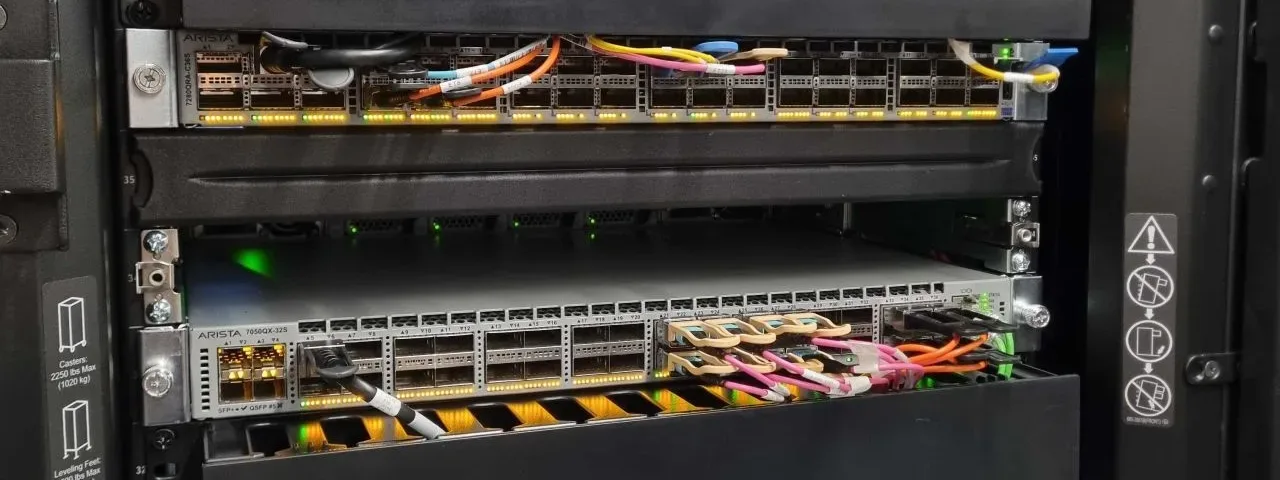
Corero NTD1100 inline mitigation appliance, photographed before installation at one of our PoPs.

DDoS protection here is not a separate product you route to when something goes wrong. It runs inline and always on, at the same network edge that carries your transit. Traffic is inspected and filtered before it reaches you, so an attack is absorbed in the backbone rather than at your doorstep.

Every metro has its own Corero NTD1100 in the forwarding path, so an attack is dropped where it lands rather than hauled to a scrubbing centre first. There is no redirect to wait for: attack traffic is filtered in under a second.

Mitigation profiles are tuned for the traffic our customers actually run: common web and application patterns, and specific game-server titles. You keep self-service control over the filtering rules for your own prefixes.

  • What's included
  • Inline at every location: no redirect, no scrubbing-centre delay
  • Corero NTD1100 in the path, filtering in under a second
  • Filtering at the network edge, ahead of your host
  • Profiles tuned for application and game-server traffic
  • Self-service filtering rules for your own address space

IPv4, IPv6 and bring-your-own-IP

Lease IPv4 and IPv6 from our pools, or bring your own space and let us announce it for you.

Need addresses? Lease IPv4 and IPv6 from our pools, sized to your deployment. Already hold your own space? Bring it: we will announce your prefixes from AS55285 once we have a valid Letter of Authorisation and your IRR and RPKI (ROA) records line up.

Additional IPv4 addresses are available for a small monthly fee, and are always assigned as a subnet rather than as scattered single addresses, so your allocation stays contiguous and routable as one prefix — ask your account contact for current pricing.

Everything is dual-stack by default. IPv6 is native on our network, not bolted on, so you can build IPv6-first and treat IPv4 as the compatibility layer it is becoming.

  • What's included
  • IPv4 from our pools for a monthly fee, always in subnets — ask for current pricing
  • IPv6 allocations, native and dual-stack
  • BYOIP: we announce your prefixes with a valid Letter of Authorisation
  • IRR and RPKI (ROA) guidance so your routes validate cleanly

Cross-connects, peering and colocation

Meet us in carrier-neutral facilities across North America and Europe, with no middle-mile in between.

Our routers sit in carrier-neutral facilities operated by the likes of Netrality, DataBank and Digital Realty. If you are in one of the same buildings, or can reach them, a cross-connect puts your equipment directly onto our fabric, with no middle-mile in between.

We peer settlement-free at the internet exchanges we sit on, with an open policy registered on PeeringDB, and offer remote hands for the times you cannot be on site. See the full live footprint on our network page, and facility addresses and compliance on our datacenters page.

  • What's included
  • Private cross-connects in our carrier-neutral facilities
  • Open, settlement-free peering at the exchanges we sit on
  • Remote hands when you cannot be on site
  • Compliance-audited buildings

Who we exchange traffic with

Direct, settlement-free sessions with the networks your users actually sit behind, so their traffic never detours through a third-party transit provider.

All 626 peers on bgp.tools

626

Peer networks

4

Upstream carriers

210

Downstream customers

6

Internet exchanges

Microsoft

AS8075

Amazon

AS16509

Google

AS15169

Apple

AS714

Cloudflare

AS13335

Akamai

AS20940

Fastly

AS54113

Valve

AS32590

Hetzner

AS24940

OVHcloud

AS16276

DigitalOcean

AS14061

Internet exchanges

Open, settlement-free peering with everyone on the route servers

NL-ix
Frys-IX
1-NL
LSIX
Speed-IX
INTERIX

Don't take our word for it

Run a BGP lookup, ping or traceroute from any of our locations against your own network. Our public looking glass shows you exactly how our routing behaves, before you sign anything.

Get a transit quote

Pricing is matched to your traffic profile. Send us these four things and the network team will come back with options.

  • 1Expected traffic volume and 95th-percentile commit
  • 2Target metros, and whether you need more than one
  • 3The prefixes you will announce, and your ASN
  • 4Timeline, and whether you need a cross-connect

Replies come from the network engineers who run AS55285, typically within one business day.

Frequently asked questions

Still unsure? Ask the network team directly.

IP transit is the service of carrying your traffic to and from the rest of the internet over a provider's network. You establish a BGP session, announce your IP prefixes, and receive a route to everywhere the provider connects. It is how networks (hosting companies, ISPs, enterprises) reach the global internet without peering with everyone individually.